

Overview
The Gateway Exposome Coordinating Center (GECC) is seeking pilot projects that advance research on the various environmental exposures over the life course — known as the “exposome” — that affect Alzheimer’s Disease (AD) and AD-Related Dementias (ADRD) risk, resilience, and disparities. The GECC anticipates selecting between 5-8 proposals to receive between $32,000-60,000 each (including indirect costs).
Pilot projects should support the GECC’s overarching mission to improve knowledge and understanding of AD/ADRD, driving policy changes and providing better data for future research. The most competitive pilot projects will create novel measures, data sets, or data guidance for exposome research. Projects may be related to or build on one or more of the six GECC domains of study: climate, physical environment, social environment, policy environment, community services environment, and life experiences. Pilots focused on methodological topics cutting across multiple substantive domains are encouraged. If you have questions about whether your project is a good fit for the GECC, please contact us at pilots@gatewayexposome.org.
Pilot project awardees will be affiliated with a domain or the methods core, and the domain or methods lead will be responsible for identifying a research mentor (either within the GECC investigative team or expert collaborators) for the awardee. The purpose of assigning a mentor is to ensure awardees have a senior researcher to provide feedback over the course of the pilot project. Affiliating pilot project awardees with a domain or methods lead will also ensure that pilot project findings are integrated into the general domain- or methods-specific efforts, including dissemination of data, findings, and guidance.
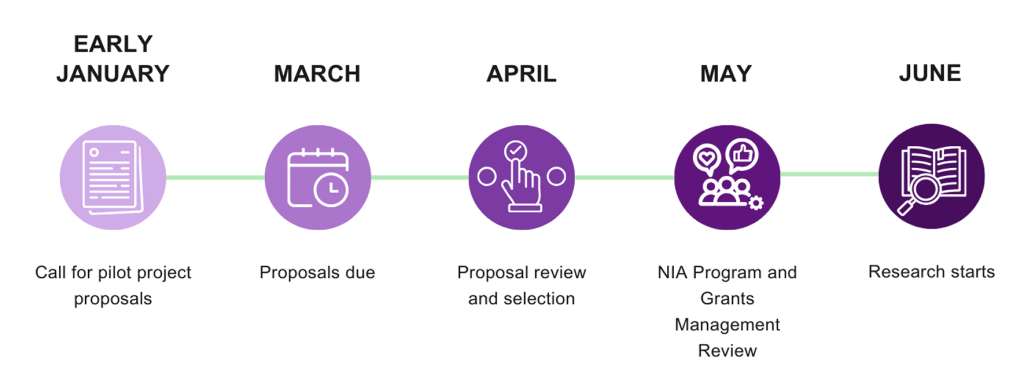
Project Period: June 1, 2025–May 31, 2026
Proposal Due Date: April 14, 2025
Eligibility
We welcome pilot studies across disciplines and from new and early-stage investigators or established investigators transitioning into AD/ADRD research, researchers from less traditional disciplines than those that normally engage in AD/ADRD research, and those working with underrepresented groups.
International proposals are welcome, as are those from public and private non-profit organizations, institutions of higher education, hospitals, and non-profit research institutes.
Required Elements of a Proposal
Primary documents
- Specific aims (1 page)
- Research strategy (up to 2 pages)
- Significance
- Innovation
- Approach (including methods, data, and scientific merit)
See NIH’s research application guide if you have questions on the intended content of these sections (pages R-84 to R-86)
Supporting documents
- References
- Research Team list and biosketch
- Biosketch in current NIH format (link); eRA Commons account is not required for first round submissions
- Budget and Budget Justification
Proposals should by typeset on 8.5 by 11-inch documents, with 0.5-inch margins, and be in 11-point Arial font.
Evaluation Criteria
Applications will be evaluated on the following criteria:
- Significance, innovation, and approach
- Alignment with NIH goals and the GECC’s aims (link)
- Project’s potential to grow into a larger research project and/or to make a significant advancement to the GECC’s aims
How to Apply
Applicants should submit all materials (in the order listed above) as a single PDF to pilots@gatewayexposome.org.
Award Notification
Applicants will be notified of funding decisions in June or July.
Questions
For questions about the application process, please email pilots@gatewayexposome.org.